I’m going to start off by saying that I am not an expert on the Inuit experience in Canada. I grew up with a dad who would travel to Yellowknife every summer for work, and taught me about life in the north, but I have no personal experiences or ties with Inuit culture.
At the Canadian Museum of Nature, there is an exhibit on the fourth floor called the Canada Goose Arctic Gallery. It contains a variety of changing exhibits, including – at the time of writing this – the Beyond Ice multimedia experience. A film of life in the Arctic is projected onto giant blocks of ice, and it’s a really neat installation that I recommend checking out.
I’ve seen a lot of people posing with it on Instagram (myself included) because, let’s face it, it’s super Insta-worthy. And that’s fine. But I’ve noticed that people will only be posting pictures of the ice blocks lit up in blue, or occasionally with the variety of Arctic wildlife in the film (narwhals, polar bears, and the like). But a significant portion of the film is dedicated to the lives of First Nations and Inuit peoples who are living in Canada’s North, and you never see them in any of the shots on Instagram. I’m guilty of this myself, as I carefully timed my running in and out of the sculpture to get this shot before the film loop started playing again. And that got me thinking. Because as much as we as Canadians like to embrace the aesthetic of the First Nations and Inuit cultures, we tend to ignore the realities of how these groups live.
The aesthetics of Inuit culture that we embrace are the same cultural elements that the Canadian government discouraged for most of the country’s history. Though now the country embraces the culture as a part of Canadian history and identity, there is little acknowledgement of the realities that these communities face, including widespread poverty.

The picture on the left was originally an outtake. I’m in too much shadow, and the visuals on the ice are children playing in their community. Not what I was going for, aesthetic-wise. But I keep thinking about the boy in the green jacket.
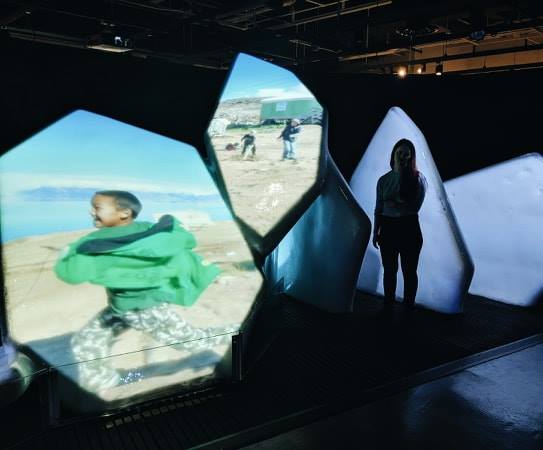
He is one of many children growing up in the north, and he and his family are faced with the reality of life one of Canada’s northern communities. And I guess the reality of these communities is what I started to struggle with. We see the idealized version of the traditional Inuit lifestyle that is curated and shown to us by people wanting to appreciate the beauty of a different culture, and that’s fine. Less so, we see the hardships and dangers that contemporary northern communities face, by groups that want to bring awareness to genuine issues, and that’s just as important. But the the boy in the green jacket showed me a certain level of reality of life in the Arctic. Though the poverty is apparent in his surroundings, there is also joy and playfulness and hope.
It’s nice to be able to create ideal images of our lives like we do on social media, but it’s also important to acknowledge certain realities when we are confronted with them. And I think that’s the purpose of Beyond Ice. At least, that’s what I got from it: to look at the Arctic as a real place, not an idealized one, and to look at the Inuit people in the same way. Beyond Ice is the perfect lead-in to the rest of the Northern Voices and Arctic Hall, as it prepares you to learn about various aspects of Inuit culture and life in the North, not just a glossy idealization of it.
If you’ve made it all the way to the end of my ramble, I’d love to know what you think, so please leave a comment either here or over on my Instagram.
If you want to learn more about the way of life for northern communities, this website has a lot of interesting information on both traditions and contemporary lifestyle, and I recommend giving it a read.
 travelbloom